Category Archives: Consumption

Overpopulation and the Collapse of Civilization By Paul Ehrlich

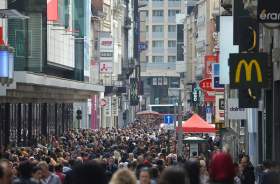
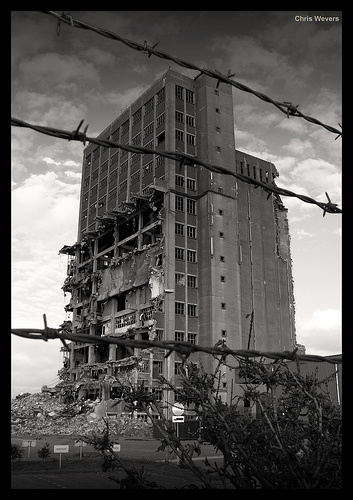
Perpetual growth is unsustainable and will lead to collapse.  Photo by Chris Wevers.

Perpetual growth is unsustainable and will lead to collapse. Photo by Chris Wevers.

A major shared goal of the Millennium Alliance for Humanity and the Biosphere (MAHB) and Sustainability Central is reducing the odds that the “perfect storm” of environmental problems that threaten humanity will lead to a collapse of civilization. Those threats include climate disruption, loss of biodiversity (and thus ecosystem services), land-use change and resulting degradation, global toxification, ocean acidification, decay of the epidemiological environment, increasing depletion of important resources, and resource wars (which could go nuclear). This is not just a list of problems, it is an interconnected complex resulting from interactions within and between what can be thought of as two gigantic complex adaptive systems: the biosphere system and the human socio-economic system. The manifestations of this interaction are often referred to as “the human predicament.” That predicament is getting continually and rapidly worse, driven by overpopulation, overconsumption among the rich, and the use of environmentally malign technologies and socio-economic-political arrangements to service the consumption.

All of the interconnected problems are caused in part by overpopulation, in part by overconsumption by the already rich. One would think that most educated people now understand that the larger the size of a human population, ceteris paribus, the more destructive its impact on the environment. The degree of overpopulation is best indicated (conservatively) by ecological footprint analysis, which shows that to support today’s population sustainably at current patterns of consumption would require roughly another half a planet, and to do so at the U.S. level would take four to five more Earths.

The seriousness of the situation can be seen in the prospects of Homo sapiens’ most important activity: producing and procuring food. Today, at least two billion people are hungry or badly in need of better diets, and most analysts think doubling food production would be required to feed a 35% bigger and still growing human population adequately by 2050. For any chance of success, humanity will need to stop expanding land area for agriculture (to preserve ecosystem services); raise yields where possible; increase efficiency in use of fertilizers, water, and energy; become more vegetarian; reduce food wastage; stop wrecking the oceans; significantly increase investment in sustainable agricultural research; and move feeding everyone to the very top of the policy agenda. All of these tasks will require changes in human behavior long recommended but thus far elusive. Perhaps more critical, there may be insurmountable biophysical barriers to increasing yields - indeed, to avoiding reductions in yields - in the face of climate disruption.

Most people fail to realize the urgency of the food situation because they don’t understand the agricultural system and its complex, non-linear connections to the drivers of environmental deterioration. The system itself, for example, is a major emitter of greenhouse gases and thus is an important driver of the climate disruption that seriously threatens food production. More than a millennium of change in temperature and precipitation patterns is now entrained, with the prospect of more crop-threatening severe storms, droughts, heat waves, and floods- all of which are already evident. Thus maintaining - let alone expanding - food production will be ever more difficult in decades ahead.

Furthermore, agriculture is a leading cause of losses of biodiversity and the critical ecosystem services supplied to agriculture itself and other human enterprises, as well as a major source of global toxification, both of which pose additional risks to food production. The threat to food production of climate disruption alone means that humanity’s entire system for mobilizing energy needs to be rapidly transformed in an effort to hold atmospheric warming well below a lethal 5o C rise in global average temperature. It also means we must alter much of our water-handling infrastructure to provide the necessary flexibility to bring water to crops in an environment of constantly changing precipitation patterns.

Food is just the most obvious area where overpopulation tends to darken the human future - virtually every other human problem from air pollution and brute overcrowding to resource shortages and declining democracy is exacerbated by further population growth. And, of course, one of our most serious problems is the failure of leadership on the population issue, in both the United States and Australia. The situation is worst in the U.S. where the government never mentions population because of fear of the Catholic hierarchy specifically and the religious right in general, and the media keep publishing ignorant pro-natalist articles, and in Australia even advertise on prime-time TV to have more kids.

A prime example was a ludicrous 2010 New York Times screed by David Brooks, calling on Americans to cheer up because “Over the next 40 years, the U.S. population will surge by an additional 100 million people, to 400 million.” Equal total ignorance of the population-resource-environment situation was shown in 2012 by an article also in the New York Times by one Ross Douthat “More Babies, Please” and one by a Rick Newman in the USNews “Why a falling birth rate is a big problem,” both additional signs of the utter failure of the US educational system.

A popular movement is needed to correct that failure and direct cultural evolution toward providing the “foresight intelligence” and the agricultural, environmental, and demographic planning that markets cannot supply. Then analysts (and society) might stop treating population growth as a “given” and consider the nutritional and health benefits of humanely ending growth well below 9 billion and starting a slow decline. In my view, the best way to accelerate the move toward such population shrinkage is to give full rights, education, and job opportunities to women everywhere, and provide all sexually active human beings with modern contraception and backup abortion. The degree to which that would reduce fertility rates is controversial, but it would be a win-win for society. Yet the critical importance of increasing the inadequate current action on the demographic driver can be seen in the decades required to change the size of the population humanely and sensibly. In contrast we know from such things as the World War II mobilizations that consumption patterns can be altered dramatically in less than a year, given appropriate incentives.

The movement should also highlight the consequences of such crazy ideas as growing an economy at 3-5% per year over decades (or forever) as most innumerate economists and politicians believe possible. Most “educated” people do not realize that in the real world a short history of exponential growth does not imply a long future of such growth. Developing foresight intelligence and mobilizing civil society for sustainability are central goals of the Millennium Alliance for Humanity and the Biosphere (“the MAHB” - mahb.stanford.edu), goals now also a major mission of the University of Technology, Sydney.

Source: http://mahb.stanford.edu/blog/overpopulation-and-the-collapse-of-civilization/
 

2 Comments

Filed under Climate, Consumption, Ecological Footprint, Economy, Environment, Growth, Population, Sustainability

Overpopulation and Climate Change, from the Center for Biological Diversity

The largest single threat to the ecology and biodiversity of the planet in the decades to come will be global climate disruption due to the buildup of human-generated greenhouse gases in the atmosphere. People around the world are beginning to address the problem by reducing their carbon footprint through less consumption and better technology. But unsustainable human population growth can overwhelm those efforts, leading us to conclude that we not only need smaller footprints, but fewer feet.

Portland, Oregon, for example, decreased its combined per-capita residential energy and car driving carbon footprint by 5 percent between 2000 and 2005. During this same period, however, its population grew by 8 percent.

A 2009 study of the relationship between population growth and global warming determined that the “carbon legacy” of just one child can produce 20 times more greenhouse gas than a person will save by driving a high-mileage car, recycling, using energy-efficient appliances and light bulbs, etc. Each child born in the United States will add about 9,441 metric tons of carbon dioxide to the carbon legacy of an average parent. The study concludes, “Clearly, the potential savings from reduced reproduction are huge compared to the savings that can be achieved by changes in lifestyle.”

One of the study’s authors, Paul Murtaugh, warned that: “In discussions about climate change, we tend to focus on the carbon emissions of an individual over his or her lifetime. Those are important issues and it’s essential that they should be considered. But an added challenge facing us is continuing population growth and increasing global consumption of resources. . . . Future growth amplifies the consequences of people’s reproductive choices today, the same way that compound interest amplifies a bank balance.”

The size of the carbon legacy is closely tied to consumption patterns. Under current conditions, a child born in the United States will be responsible for almost seven times the carbon emissions of a child born in China and 168 times the impact of a child born in Bangladesh.

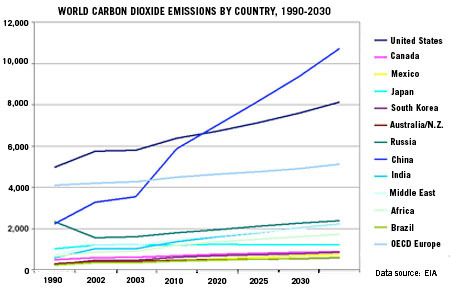
The globalization of the world economy, moreover, can mask the true carbon footprint of individual nations. China, for example, recently surpassed the United States to become the world’s leading greenhouse gas emitter. But a large portion of those gases is emitted in the production of consumer goods for the United States and Europe. Thus a large share of “China’s” greenhouse gas footprint is actually the displaced footprint of high-consumption western nations.

WorldCarbonEmiss

The United States has the largest population in the developed world, and is the only developed nation experiencing significant population growth: Its population may double before the end of the century. Its 300 million inhabitants produce greenhouse gases at a per-capita rate that is more than double that of Europe, five times the global average, and more than 10 times the average of developing nations. The U.S. greenhouse gas contribution is driven by a disastrous combination of high population, significant growth, and massive (and rising) consumption levels, and thus far, lack of political will to end our fossil-fuel addiction.

More than half of the U.S. population now lives in car-dependent suburbs. Cumulatively, we drive 3 trillion miles each year. The average miles traveled per capita is increasing rapidly, and the transportation sector now accounts for one-third of all U.S. carbon emissions.

Another one-fifth of U.S. carbon emissions comes from the residential sector. Average home sizes have increased dramatically in recent decades, as has the accompanying footprint of each home. Suburban sprawl contributes significantly to deforestation, reducing the capacity of the planet to absorb the increased CO2 we emit. Due to a dramatic decrease in household size, from 3.1 persons per home in 1970 to 2.6 in 2000, homebuilding is outpacing the population growth that is driving it. More Americans are driving farther to reach bigger homes with higher heating and cooling demands and fewer people per household than ever before. All of these trends exacerbate the carbon footprint inherent in the basic energy needs of a burgeoning U.S. population.

Globally, recent research indicates that assumptions regarding declining fertility rates used by the Intergovernmental Panel on Climate Change to develop future emissions scenarios may be overly optimistic. While fertility rates have generally declined over the past few decades, progress has slowed in recent years, especially in developing nations, largely due to cutbacks in family planning assistance and political interference from the United States. And even if fertility rates are reduced to below replacement levels, population levels will continue to climb steeply for some time as people live longer and billions of young people mature and proceed through their reproductive years. Per-capita greenhouse gas emissions may drop, but the population bulge will continue to contribute to a dangerous increase in greenhouse gases in the atmosphere.

Time is short, but it not too late to stop runaway global warming. Economy-wide reduction of greenhouse gas emissions to a level that brings atmospheric CO2 back from 386 parts per million to 350 or less, scaling back first-world consumption patterns, and long-term population reduction to ecologically sustainable levels will solve the global warming crisis and move us to toward a healthier, more stable, post-fossil fuel, post-growth addicted society.

Source: The Center for Biological Diversity, http://www.biologicaldiversity.org/campaigns/overpopulation/climate/index.html

At the Center for Biological Diversity, we believe that the welfare of human beings is deeply linked to nature — to the existence in our world of a vast diversity of wild animals and plants. Because diversity has intrinsic value, and because its loss impoverishes society, we work to secure a future for all species, great and small, hovering on the brink of extinction. We do so through science, law and creative media, with a focus on protecting the lands, waters and climate that species need to survive.

We want those who come after us to inherit a world where the wild is still alive.

Leave a comment

Filed under Climate, Consumption, Ecological Footprint, Energy, Growth, Population, Sustainability

Don’t Worry-Be Resilient by Charles Hugh Smith

Family fun. Photo by Keith Brofsky/Artville

Family fun. Photo by Keith Brofsky/Artville

At some point, absorbing more information about the unsustainability of modern society yields diminishing returns. It becomes emotionally draining and thus counterproductive. Part of this exhaustion results from recognizing our powerlessness within the Status Quo, where independent thinking and structural innovation are intentionally winnowed out as threats to existing institutions and industries. Another part arises from the burden of knowing that the supposedly permanent Status Quo is far more vulnerable than generally believed.

A related factor that is never publicly discussed is the negative impact on our mental health of all the propaganda that we are force-fed by the Mainstream Media. When truth is incrementally undermined by massaged data and behind-the-façade manipulation, we lose faith in key State and media institutions and suffer from a propaganda-induced disconnect between what we see and what is reported as fact.

These “burdens of knowing” can diminish the small but real joys of the present: work we like, a home-cooked meal, and time spent with our friends and family. As a result, many smart, well-informed people consciously refuse to dwell on our systemic problems because doing so “is a downer.” These folks hold the perspective that anxiety about the future should not get in the way of the simple pleasures of living.

This attitude can be described as “don’t worry ~ be happy.” And it certainly makes sense when life is still comfortable and enjoyable.

But the philosophy of “thinking about the future is a downer, so I live in the present” ultimately rests on a false confidence that the future will take care of itself, regardless of what happens to the large-scale systems of State, finance, and resources. It overlooks the reality that not all responses to instability or devolution are equally successful. Those who are totally dependent on the Central State and speculation-based markets will have a much more difficult time maintaining their “happy” view if the systems they depend on erode or fail.

Perhaps the wiser response is “don’t worry ~ be resilient.” The resilient household can be happy not only in the present surplus of energy, entitlements, goods, and services, but can also thrive in a future where the current surplus of cash, credit, and speculative gains has dried up.

Life will out. Photo by RayinLA/Flickr/cc

Life will out. Photo by RayinLA/Flickr/cc

What is Resilience?

What is resilience? A dictionary definition is “an ability to recover from or adjust easily to misfortune or change.” In other words, it is on the other end of the response spectrum from fragility, brittleness, and vulnerability.

In terms of individual psychology, resilience can be characterized as being able to roll with the punches, maintaining a positive attitude through difficult times, and focusing on developing successful responses to misfortunes and challenges. American culture extols individual resilience, and we are taught to think that the individual can overcome anything and everything with the right attitude. But if the Status Quo is vulnerable to disruption on a systemic level, then it is prudent to think of resilience in a systemic way as well.

One way to describe the difference between systemic vulnerability and resilience is to conduct a thought experiment:

  • What if it didn’t matter to you and your household if the Dow Jones Industrial Average (DJIA on the NY Stock Exchange) was 14,000 or 4,000? Or if gasoline cost $3.50 or $7.50 per gallon?
  • What if it didn’t matter to you and your household if Central State [government] entitlements were slashed by half, or vanished altogether?
  • What if it didn’t matter to you and your household if your land and house were worth $1 million or $100,000?

In other words, what if the machinations of Wall Street, the Federal Reserve, the Central State and, indeed, all of Central Planning’s promises and speculation-boosting had little effect on your life or well-being? Would this make your household more resilient or more vulnerable? Clearly, the less we are dependent on systemically brittle Central Planning systems, the fewer adjustments we will have to make should these large-scale systems devolve or fail.

The important point being made here about resilience is that it does not require a sacrifice of present happiness. Nor does it profit from the devolution or failure of Central Planning. The resilient household is able to enjoy the present surplus of energy, credit, State entitlements, and consumerist abundance, but it doesn’t rely on it.

If the Status Quo is indeed as permanent as it is presented, the resilient household has the same measure of happiness as the household that is totally dependent on Central Planning promises and boundless credit. The difference between fragility and resilience is how much security and happiness will be available to the two households should the Status Quo credit-based consumption and speculative wealth turn out to be decidedly impermanent.

Debt, Fragility and Vulnerability

The easiest way to increase resilience is to reduce fragility and vulnerability. We can understand the dynamics of what we might call anti-resilience—debt, fragility, and vulnerability—with another thought experiment:

Household A’s gross income is $5,000 a month and their net income (less Federal, state and local payroll and income taxes) is $4,200 a month. The mortgage is $2,000 per month, both wage earners have substantial monthly payments on student loans, and the household also has an auto loan. The household’s healthcare insurance is partly paid by payroll deductions, and the household remains responsible for a percentage of any major medical costs. Basic living expenses eat up the rest of the net income; the household saves nothing and has minimal savings.

Household A hopes housing valuations keep rising, as they plan to borrow money off this resurgent home equity to fund a vacation, something they haven’t had for four years.

This household’s financial situation is precarious because its expenses equal its income, and most of these expenses are debt-related and cannot be trimmed. This greatly increases their fragility to financial misfortune; any reduction in take-home pay or any increase in expenses will push this household into default. To increase consumption, they plan to borrow more money once their only collateral—their home equity—increases enough to support more debt.

Household A has a high and inflexible cost-basis. Any significant reduction in income cannot be offset with equivalent cuts in spending.

Household B owns their land and home free and clear; the only housing-related payments are property taxes and property insurance. (Recall that 30% of all homes are owned free and clear in the U.S., so this is not as unusual as you might imagine.)

One wage-earner paid off her modest student loans within a few years; the other never took on student loans in the first place. They own two older vehicles free and clear. They are debt-free. Their gross income is $4,000 and their net income is $3,200. Since they have no mortgage interest deduction, their income taxes are higher as a percentage of income than Household A. Their living expenses total $1,500 per month, so they save 50% of their net income. If one of the wage earners loses their job, the household can maintain its current budget without sacrifice. Their substantial savings protect them from unforeseen medical expenses not covered by healthcare insurance, and they can pay for vacations with cash, not credit.

Let’s say that one wage earner in each household loses their job and must take a job that pays 20% less. Household A cannot cover its expenses and must default on one of their debts. Household B’s monthly savings decline, but they are still saving a substantial portion of their income.

Which household is vulnerable to even modest financial misfortune? Clearly Household A. Will a positive attitude be enough to save the family from insolvency? It will help it transition into and hopefully through bankruptcy, but a positive attitude alone is no substitute for financial resilience.

Though Keynesian economists argue that nations are not like households, in truth debt/financial fragility is scale-invariant, meaning that rising debt, a high cost basis, and zero savings/investment lead to fragility in households, enterprises, communities, and nations alike.

Conclusion

The United States of America shares a lot in common with Household A: It has a high and inflexible cost-basis, and it is dependent on borrowing to fund future consumption and on speculation to create collateral. It is also tied into spending a significant share of its income-servicing debt. History offers few examples of major nations that prospered by borrowing vast sums for consumption.

Charles Hugh Smith writes the ‘Of Two Minds’ blog <www.oftwominds.com/blog.html> which covers an eclectic range of timely topics: finance, housing, Asia, energy, long term trends, social issues, health/diet/fitness and sustainability. Smith’s books include “Weblogs and New Media: Marketing in Crisis” (2008) and “Survival+: Structuring Prosperity for Yourself and the Nation” (2009). He is currently completing “An Unconventional Guide to Investing in Troubled Times” (June 2011). Published on ‘Peak Prosperity’ <http://www.peakprosperity.com, February 12, 2013. Reprinted with permission.

Leave a comment

Filed under Consumption, Culture, Ecological Footprint, Economy, Energy, Environment, Ethics, Natural Resources, Sustainability

A New Dream Built on Resilience by Asher Miller

A new way of seeing our place within the web of life.

A new way of seeing our place within the web of life.

If you’re a lazy pessimist, times are good. After all, you don’t have to look far to see evidence that things are tough and poised to get tougher.

There’s a growing wealth chasm between the rich and, well, everyone else. Significant changes to our climate are already underway and are now largely unavoidable. Our industrial food system is having a malignant influence on people’s health and our politicians. And we are going to increasingly desperate lengths to feed our fossil fuel energy addiction. The list goes on.

And while national and international leadership are key to navigating the bumpy road ahead, thus far, that leadership is sadly wanting.

I’ll be honest—in the face of all this, I’d probably count myself among the lazy pessimists. But having kids ruined both the laziness and the pessimism. I’m sure many of you can relate.

But that doesn’t mean that we can ignore the painful reality that’s just outside the window. And if you’re anything like me, you’re wondering what can be done. One approach is to build resilient communities:

  • Resilient - because the complex economic, energy, and environmental challenges we face not only require solutions to make problems go away, but responses that recognize our vulnerabilities, build our capacities, and enable us to adapt to an increasingly unpredictable future.
  • Communities - because the future is grounded in local relationships—relationships with the ecological resources that feed and sustain us, among families and neighbors, and through the institutions we use to govern ourselves.

Thankfully, a small but growing movement of engaged citizens, community groups, businesses, and local elected officials is leading the way. These early actors have worked to reduce unbridled consumption, produce local food and energy, invest in local economies, and preserve local ecosystems. While diverse, the essence of these efforts is the same: a recognition that the world is changing and the old way of doing things no longer works.

A few months ago, my organization, Post Carbon Institute, launched a new website called ‘resilience.org’ to provide connections for concerned folks just like you and me: connections to timely information and thought-provoking essays; connections to like-minded grassroots groups and nonprofit organizations that are working to build robust, thriving communities; and connections to innovative resources and models that help us individually and collectively face these challenges head on.

Here are just few recent examples of articles and resources you can find at resilience.org:

  • All placemaking is creative: How a shared focus on place builds vibrant destinations.
  • The year of fruit: On neighbors coming together to share the bounty.
  • Energising Money: A report by New Economics Foundation on developing energy-related monetary systems.

• A conversation with Mark Lakeman of City Repair: On the development of sustainable public places.

As part of this task we’re also publishing a series of Community Resilience Guides to capture some of the most promising and replicable of these efforts: investing in the local economy, producing community-owned renewable energy, and growing local food security.

These are uncertain, challenging times. But they are also full of opportunity. And so if you’re like me (and the thousands of other folks who visit resilience.org regularly) and feel compelled to take action, I hope you’ll get engaged in the necessary, daunting, and rewarding task of building resilience at home and in your community. It’s all-hands-on-deck!

Asher Miller is the Executive Director of Post Carbon Institute and on the board of Transition US. Visit <resilience.org> to find a resilience group near you. Source: Center for a New American Dream, March 7, 2013. <http://www.newdream.org/blog/a-new-dream-built-on-resilience&gt;

Leave a comment

Filed under Consumption, Culture, Ecological Footprint, Economy, Environment, Growth, Natural Resources, Sustainability, Wildlife

Focus on U.S. - Editorial by Marilyn Hempel

Periodically we focus on U.S. issues. Why? The United States is the third most populous nation in the world, behind China and India. And because Americans are the world’s super consumers, our ecological footprint is larger than that of any other nation.

Because Americans are the world's super consumers, our ecological footprint is larger than that of any other nation.

Because Americans are the world’s super consumers, our ecological footprint is larger than that of any other nation.

U.S. population continues to grow rapidly, by approximately 3 million people per year. Indeed, the U.S. annual growth rate (0.96%) is much closer to that of developing countries such as Morocco, Vietnam and Indonesia (all at 1.07%) than to other developed nations such as Denmark (0.25%), Taiwan (0.19%) and Belgium (0.07%). The main difference is that population growth in the developing world is driven by high fertility rates, while population growth in the United States and the rest of the developed world is mostly driven by immigration—and the relatively higher fertility rate of immigrants.

U.S. consumption of natural resources has not abated either. The U.S. ranks highest in most consumer categories, even among industrialized nations. American fossil fuel consumption is double that of the average resident of Great Britain, and two and a half times that of the average Japanese. The continuing surge in numbers of Americans offsets individual efficiencies or reductions. For example, even if the average American eats 20% less meat in 2050 than is 2000, total U.S. meat consumption will be 5 million tons greater in 2050 due to population growth.* In a nutshell, our Ecological Footprint is twice that of Western European nations, and they have a high quality of life!

For the good of the planet and for the good of human civilization, the U.S.—along with all nations—should stabilize population as rapidly as possible.

Immigration is not our favorite subject, largely because almost every discussion of immigration becomes emotional, and sheds more heat than light on the subject. We have tried very hard to find articles that present facts, not feelings (although we have included some examples of ‘feeling’ articles to show the difference). As Herman Daly wisely observed, “Immigrants are people, and deserve to be well treated; immigration is a policy, and deserves rational discussion.” Don’t miss his article on page xx.

We are continuing our series on happiness and sustainable living with a look at the work of the City of Santa Monica’s sustainability program. For those of you who have requested more good news, this is an excellent example of creative thinking and positive action.

In the midst of mass shootings, bombings, and other tragic events, the United Nations declared, with almost no news coverage, the first ever International Day of Happiness (March 20, 2013). This signifies recognition of the relevance of happiness and wellbeing as universal goals in people’s lives, and acknowledgement of the importance of these goals in public policy objectives.

UN Secretary General Ban Ki-moon declared, “People around the world aspire to lead happy and fulfilling lives free from fear and want, and in harmony with nature.” There are three essential facets to happiness or wellbeing: personal, community and planetary—and all three are interconnected. We think wellbeing should be embedded in the concept of sustainable communities, as part of a global movement away from our addiction to growth.

Wellbeing supports building physical, emotional and psychological resources for genuine “wealth”. Each of us can take responsibility for contributing to ourselves, our families, friends, communities and world, rather than relying on institutions or governments to provide ‘happiness’. Good health both faciltates and results from greater happiness, but there are subtle differences between wellbeing and happiness. Happiness is often understood as a temporary emotional state, while wellbeing encompasses a longer-term sense of peace and prosperity in our lives.

Our ultimate vision is of a world in which everyone’s genuine needs are met within the limits of the planet’s resources and carrying capacity. Wellbeing for people and ecosystems will become the central measure of progress in any society interested in living sustainably.

As Mr. Ban said. “On this first International Day of Happiness, let us reinforce our commitment to inclusive and sustainable human development and renew our pledge to help others…. When we contribute to the common good, we ourselves are enriched. Compassion promotes happiness and will help build the future we want.”

*data from Worldwatch Institute

Marilyn Hempel is the editor of the Population Press.

1 Comment

Filed under Consumption, Culture, Immigration, Natural Resources, Population, Sustainability

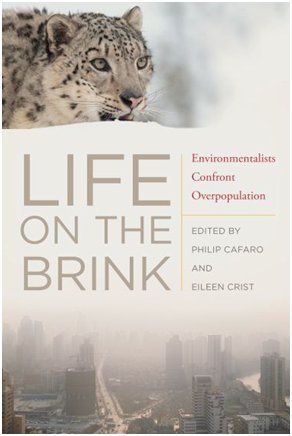
Book review: Life On The Brink: Environmentalists Confront Overpopulation

In Life on the Brink: Environmentalists Confront Overpopulation by Professor Philip Cafaro of Colorado State University and Professor Eileen Crist of Virginia Tech, we find top authors and scientists attempting to alert humanity to its impending future viability on this planet.

In Life on the Brink: Environmentalists Confront Overpopulation by Professor Philip Cafaro of Colorado State University and Professor Eileen Crist of Virginia Tech, we find top authors and scientists attempting to alert humanity to its impending future viability on this planet.

If you look around the United States, even in the overcrowded, overpacked and gridlocked cities of America—you won’t hear conversations about overpopulation. Los Angeles, Denver, Chicago and more cities feature enormous brown clouds blanketing their cities with an airborne toxic soup that every citizen breathes with every breath. Brian Williams reports on the horrific traffic jams on the East Coast, but he won’t mention the overpopulation factor causing them. Same with Diane Sawyer, Scott Pelley, Wolf Blitzer, Megyn Kelley, Robert Siegel and all the top anchors on all the media reports!

They convey that none of us should question unending growth. It’s like a 450 pound fat man on “Biggest Losers” TV show who can barely walk, knows he’s going to die of a heart attack—but he decides to follow the American mantra of “Sustainable Growth” and keeps shoving Big Macs with double cheese, French fries and a Big Gulp down his gullet until he reaches 550 pounds and beyond.

Both his path and the United States’ path can only end up in the same condition: human misery, suffering and ultimately collapse. But in the case of human overpopulation around the planet, we humans destroy millions of other creatures along the way to our own destruction.

In Life on the Brink: Environmentalists Confront Overpopulation by Professor Philip Cafaro of Colorado State University and Professor Eileen Crist of Virginia Tech, we find top authors and scientists attempting to alert humanity to its impending future viability on this planet.

In Chapter 4, Martha Campbell asks, “Why the silence on overpopulation?”

“By 2050, human population is projected to reach as high as 10.5 billion,” said Campbell. “Uganda is projected to grow from 33.8 million to 91.3 million. Niger from 16 million to 58 million, and Afghanistan from 29 million to 73 million.”

That’s not all the growth! India adds 11 million net gain annually to its 1.2 billion (in 2012), while China adds another 8 million net gain annually. Both countries expect to explode to about 1.6 billion. If you have watched NBC lately, Brian Williams reported on the air pollution cover Shanghai and Beijing. He hasn’t covered the water pollution, but the Ganges and the Yangzi Rivers feature open sewer pipes that turn into 20,000 square mile dead zones at their mouths. How do I know? I sailed on both rivers and the water-plastic-debris-trash-human waste made me sick to my stomach.

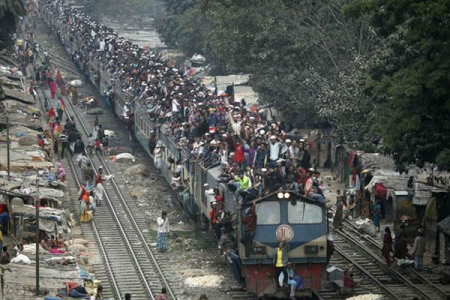
"OverLoaded Train" in India, more and more people are crammed into the same space, trying to live, breathe, grow food, find jobs and enjoy 'quality of life'.  In a country of 1.26 billion people (and still growing rapidly!) is there any room for tigers or elephants or other creatures?  Photo from churchandstate.org.uk

“OverLoaded Train” in India, more and more people are crammed into the same space, trying to live, breathe, grow food, find jobs and enjoy ‘quality of life’. In a country of 1.26 billion people (and still growing rapidly!) is there any room for tigers or elephants or other creatures? Photo from churchandstate.org.uk

At 82 million, Egypt, a country that cannot feed itself in 2013 and relies on grain imports, expects to hit 150 million by mid century. Do we need to guess their fate?

“In 1900, Ethiopia had 5 million, in 1950 it had 18.4 million, in 2010 it had 85 million and is projected to reach 173 million by 2050,” said Campbell. “Their rapid population growth figures in the decimation of nearly all of Ethiopia’s forests and consequently climate change.”

On a personal note, I researched to find that Africa houses nearly 1 billion people in 2013, but expects to reach 3.1 billion within 90 years. Can you imagine every human scavenging every last creature on this beautiful continent for food? Nothing will be left of all those wonderful creatures. In 1900, Africa sported 12 million elephants. Today, 475,000 remain and their numbers are dwindling fast due to poachers.

Campbell calls the subject of population “delicate” because it involves sex, cultures, religions and serves inequities around the world. Such religions as Islam, the Catholic Church, and many others don’t take kindly to birth control.

Campbell discusses the six reasons for the population “Perfect Storm” facing all life on this planet, especially humans causing it.

  1. While birth rates fall, the sheer number of humans causes growth, due to ‘population momentum’. Right now that momentum adds about 1 billion people every 12-13 years.
  2. Overconsumption of water, resources, animal life, arable land and resource exhaustion accelerate with the population momentum.
  3. Anti-abortion activists, religious leaders and conservative think tanks have intentionally reduced attention to population growth.
  4. Many folks think that disease like AIDS have stopped population growth. Not so!
  5. Even after the Cairo population conference and the Rio debates, there is still not enough financing of family planning programs on a global level. Cultural and religious practices still dominate women in too many places.
  6. The dominant “endless growth” paradigms of countries like Canada, America, Australia and even Europe—maintain a death grip on any discussion of overpopulation.
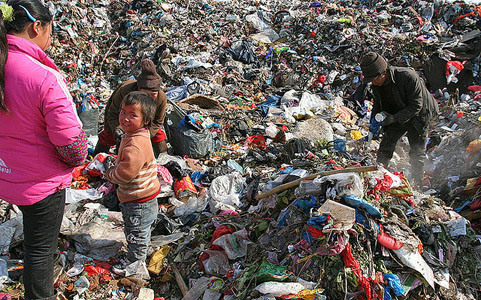
"Garbage Family"  Despite China's rapid economic growth and strict no-migration laws, there remains a marked disparity between the country's wealthy and the poor. This family, originally from Guizhou Province (far-western China) moved to the rich Delta Yangtze River coast in search of a better life. They currently work in a Jiangsu landfill, sifting through garbage in search of any re-sellable items.  In a country of 1.35 billion people (and still growing!) -- is there any room for Pandas or any other wildlife?  Photo and commentary by Sheilaz314/Flickr/cc

“Garbage Family” Despite China’s rapid economic growth and strict no-migration laws, there remains a marked disparity between the country’s wealthy and the poor. This family, originally from Guizhou Province (far-western China) moved to the rich Delta Yangtze River coast in search of a better life. They currently work in a Jiangsu landfill, sifting through garbage in search of any re-sellable items. In a country of 1.35 billion people (and still growing!) — is there any room for Pandas or any other wildlife? Photo and commentary by Sheilaz314/Flickr/cc

Campbell said, “Use of family planning prevents death from unintended pregnancies and from induced abortions. Children from smaller families are more likely to enter and stay in school.”

This chapter brings home the enormity of the power of cultures and churches and corporations to squash the population discussion. It shows that cultures and beliefs trump and override reason, empirical evidence, common sense and logical action.

Thus, 10 million children and 8 million adults die of starvation and starvation related conditions every year around the globe. Another 18 million stand in the doorway of death in 2013. All life on the brink? If we do nothing about overpopulation, iit’s only a matter of time.

Frosty Wooldridge has bicycled across six continents—from the Arctic to the South Pole—as well as eight times across the USA, coast to coast and border to border. He presents “The Coming Population Crisis facing America: what to do about it” at <www.frostywooldridge.com>. His latest book is: How to Live a Life of Adventure: The Art of Exploring the World, copies at 1-888-280-7715.

2 Comments

Filed under Consumption, Environment, Family Planning, Growth, Human Rights, Population, Sustainability, Wildlife, Women's Rights

Study: World Population Increase Could Force Us All to be Vegetarians by 2050 Chad Love

Vegetarians returning from the hunt.

Recently, more than a few headlines have proclaimed that humanity may have to go vegetarian by 2050 due to exploding population growth and dwindling food supplies. Based on a study by the Stockholm International Water Institute, these headlines seem incredible and alarmist—but now even the iconic U.S. magazine, Field and Stream, is covering the story.

From the story in the (UK) Guardian:

Leading water scientists have issued one of the sternest warnings yet about global food supplies, saying that the world’s population may have to switch almost completely to a vegetarian diet over the next 40 years to avoid catastrophic shortages. Humans derive about 20% of their protein from animal-based products now, but this may need to drop to just 5% to feed the extra 2 billion people expected to be alive by 2050, according to research by some of the world’s leading water scientists. “There will not be enough water available on current croplands to produce food for the expected 9 billion population in 2050 if we follow current trends towards diets common in western nations,” reported Malik Falkenmark and colleagues at the Stockholm International Water Institute (SIWI).

According to the story, a meat-based diet consumes five to ten times more water than a largely vegetarian diet, and with one-third of the world’s arable cropland already used to grow feed for animals, the world simply doesn’t have enough resources to continue that trend for the two billion or so new mouths expected to be needing food by 2050.

Now, that is certainly a provocative assertion, and you can argue the merits (or lack thereof) of this study until you’re blue in the face, but the fact is, the world is in something of a sticky wicket, sustenance-wise. Commodity prices are sky-high, worldwide stocks are low, and sustained drought and other various and sundry weird weather is turning (for lack of a better term) “food bleakness” into something of the new normal. And while we, as proud hunter-gatherers, like to (sometimes a little too smugly) brag about how much we’re unaffected by the whims of food prices due to all that wild game we eat, that’s bollocks, really. The truth is, we, as hunters and anglers are just as dependent on the whims and vagaries of the worldwide food system as any non-hunting supermarket-dependent urban dweller.

Don’t believe me? Just ask any midwestern or plains state bird hunter what’s happening in the nation’s breadbasket. Ground that hasn’t seen a plow for decades (and probably with good reason) is being turned over and converted to farmland at a pace that is beyond breathtaking. In fact, 23 million acres of fallow grassland have been converted to crop production in the past five years.

To put that in perspective, that’s an area about the size of the state of Indiana. How much upland bird, waterfowl and deer habitat do you think that is? And in addition, beyond habitat loss, how do you think skyrocketing food prices are going to affect game and fish populations? We’re already seeing an increase in hunting and fishing activity in this country.

Do you really think that increased interest can be attributed to those silly television hunting shows, or does a lousy economy and higher meat prices have more and more people eying all that free-range protein out there? Now multiply that by a factor of ten, or twenty, if meat prices keep going up (and just ask any cattle rancher about that…). How do you think that increased pressure is going to affect your hunting?

The point is, as easy as it is, we just can’t scoff at or laugh off newspaper headlines about the whole world going veg, because as ludicrous as it sounds, the underlying issues that lead scientists to make such assertions are distinctly not. And as much we like to deny it, the future of hunting and fishing in America will be in some part shaped by external factors, and may end up being vastly different than what it looks like today.

The question is, what should we do about it? Is there anything we can do about it?

Source: Field and Stream magazine blog, August 29, 2012. <http://www.fieldandstream.com/blogs/field-notes/2012/08/study-humans-switch-vegetarian-diet-avoid-food-shortage >

1 Comment

Filed under Consumption, Natural Resources, Population, Sustainability